
Bachata Classes for Couples: A 2026 Guide
Table of Contents
Why Bachata Is the Ideal Partner Dance for Couples
Beginner Bachata Classes: What You Need to Know
What to Expect at a Bachata Class
Bachata Classes With Partner: Group vs. Private Lessons
Group Classes for Couples
Private Lessons and Home Tuition
A Simple Decision Framework
Sensual Bachata Classes: Understanding the Style
Choosing the Right Bachata Class for Your Couple's Journey
Step 1: Define What You Actually Want
Step 2: Audit the Logistics Before the Syllabus
Step 3: Compare Total Cost, Not Headline Price
Step 4: Use a Consistent Quality Rubric
Step 5: Decide Between Group, Private, and Home
Step 6: Set a Review Point
Frequently Asked Questions
Last Updated: October 16, 2026
Why Bachata Is the Ideal Partner Dance for Couples
Bachata is a partner dance from the Dominican Republic and one of the world's most popular social dances (Music and dance of Dominican Bachata). Its lead-and-follow relationship creates an intimate, collaborative experience that strengthens both your dancing and your relationship.
Bachata suits couples because it emphasizes closeness and communication. Physical contact and nonverbal cues build trust and synchronization, and learning together becomes a shared journey rather than a competition.
The basic step is accessible to absolute beginners: just eight counts of movement, far less intimidating than many partner dances. You can enjoy it within your first class, regardless of prior experience.
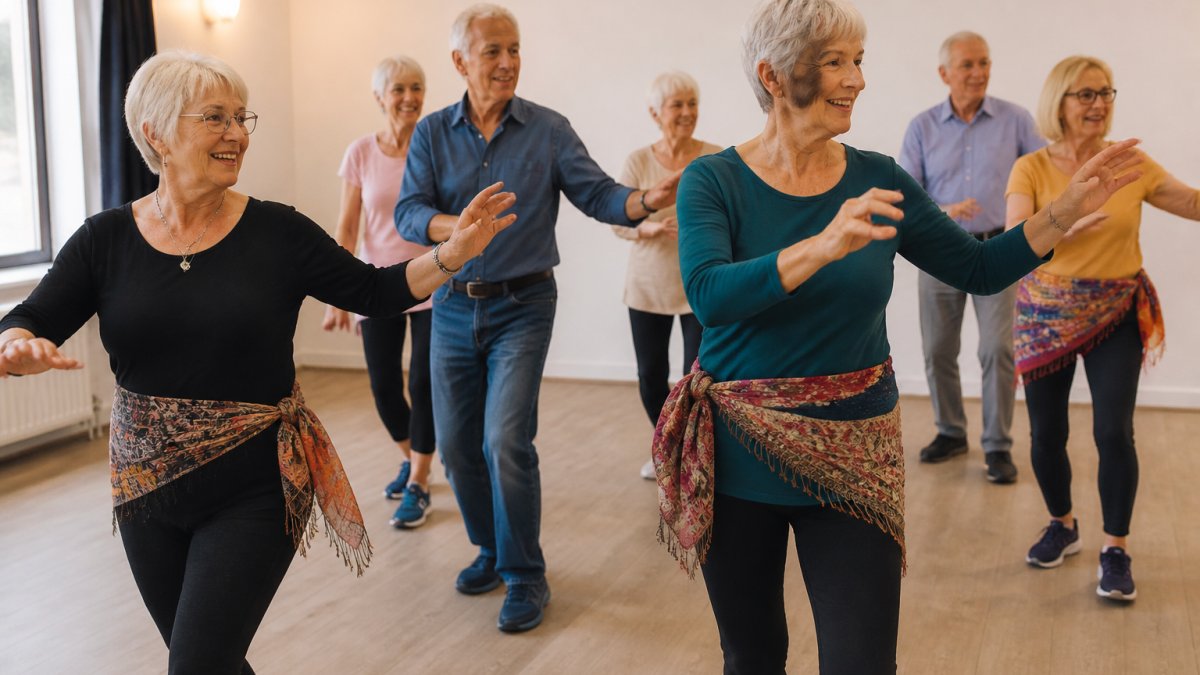
Bachata is flexible: take group classes, private lessons, or practice at home. It works for all fitness levels and ages, from seniors seeking low-impact movement to younger couples wanting an energetic social activity.
Beginner Bachata Classes: What You Need to Know
Starting bachata as a complete beginner is normal. Studios welcome newcomers constantly, and instructors design beginner classes for people with zero prior experience.
In beginner bachata classes for couples, instructors break down every movement step-by-step. You learn the basic eight-count rhythm first, then add turns, spins, and styling as confidence grows.
A common concern is feeling out of place. In reality, beginner classes attract people at exactly your level, and instructors create a supportive environment where mistakes are part of learning.
One practical advantage of starting as a couple is having a built-in partner. You avoid rotating partners or waiting on the sidelines, so you can focus entirely on technique rather than social dynamics.
The time commitment is flexible. Many studios offer drop-in classes weekly, while others sell packages over several weeks.
What to Expect at a Bachata Class
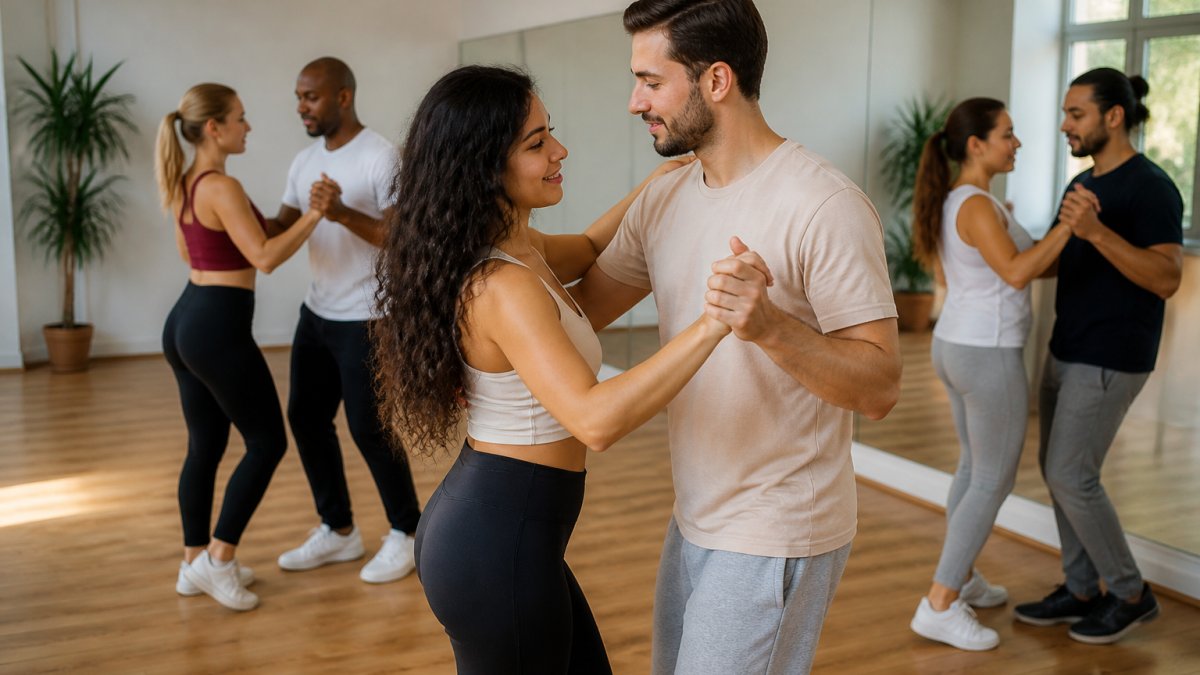
A typical bachata class takes place in a studio with mirrors, a sound system playing bachata music, and an instructor ready to guide you.

Classes usually begin with a warm-up, gentle stretching, footwork drills, or simple movements set to music, to prepare you for the main lesson.
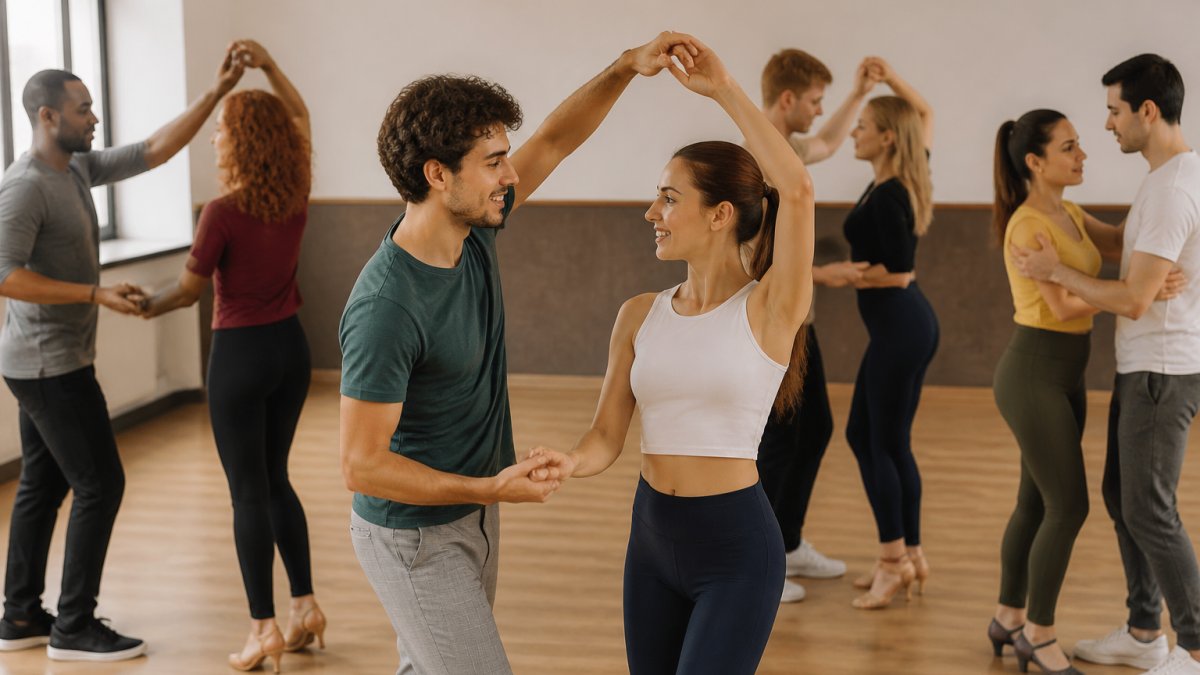
After the warm-up, the instructor teaches the core content, breaking the basic step into pieces: the lead's movements, then the follower's, then practicing together.
Most classes include a practice period. Repetition cements movements into muscle memory, and instructors adjust your posture, frame, or timing.
The atmosphere is upbeat, with music loud enough to dance to but not so loud that you miss the instructor's cues.
Bachata Classes With Partner: Group vs. Private Lessons
Most couples face the same early decision: group class, private lessons, or home tuition. The right answer depends on how you learn, how often you can attend, and your budget.
Group Classes for Couples
Group classes are the default entry point and, for most couples, the right one. You learn alongside other couples at a similar level, which normalises the beginner experience and provides a ready-made social circle.
Partner policy matters more than price. Ask the studio directly:
Do couples stay paired for the whole class, or is there partner rotation?
If rotation happens, is it optional for couples?
Are there enough leads and followers, or will one of you be asked to switch roles?
A common pattern: beginner courses rotate partners to build adaptability, while socials and intermediate classes let couples stay together. If you want to dance only with each other, confirm before booking, some studios accommodate a fixed pair, others will not. Establishing this preference early ensures your evening remains focused on connection, which serves as a perfect foundation for exploring various date night ideas throughout the city.
Typical cost structure. Group courses are usually sold as a block. Drop-ins cost more per class, and trial classes are often reduced or free for first-timers.
Trade-offs to weigh:
Lower cost per person, because the instructor's time is shared.
Built-in social practice and a regular weekly rhythm.
Less individual correction; the instructor cannot spend long on one couple's specific issue.
You move at the group's pace, which can feel slow or fast depending on the room.
Private Lessons and Home Tuition
Private lessons put the instructor's full attention on you two. If one of you struggles with leading or following, or you have a specific goal (a wedding first dance, faster progress), private instruction fixes it far quicker than a group setting.
What private lessons are good for:
Correcting a specific habit, such as a heavy lead or a late follow.
Preparing choreography for an event.
Couples with mismatched experience levels, where one partner is far ahead.
Irregular schedules that do not fit a fixed weekly course.
Typical cost structure. Private lessons are priced per session, not per person, and cost significantly more per hour than group classes. Studios often sell packs of 5 or 10 at a lower rate, and some offer a discounted "couple rate."
Home tuition. Some instructors travel to you, removing travel time and feeling more relaxed. But you need clear floor space, a speaker, and a surface safe for turns, and you lose the mirrors and sprung floors that help you check posture.
A Simple Decision Framework
Your situation | Best starting format |
Complete beginners, want to meet other couples | Group beginner course |
One partner has danced before, the other has not | Private lessons first, then group |
Preparing for a wedding or event | Private lessons, ideally a short block |
Tight budget, want to try before committing | Trial or drop-in group class |
Unpredictable work schedules | Private lessons or drop-in group classes |
Want to progress fast | Private lessons plus weekly group practice |
A common, effective pattern: start with a group beginner course to build basics and the social habit, then add occasional private lessons when you hit a plateau. That gives you the affordability and community of group classes plus targeted correction.
Pro Tip Before booking anything, ask three questions: Is the price per person or per couple? Do couples stay paired or rotate? Is there a trial class? The answers will tell you more about whether a studio suits couples than any marketing page will.
Sensual Bachata Classes: Understanding the Style
Sensual bachata is an evolution of the traditional dance, emphasizing fluid body movement, isolation, and emotional expression alongside footwork.
Traditional bachata focuses on precise footwork and partner connection. Sensual bachata keeps the partnership but adds body rolls, hip movements, and vertical space, with the torso moving independently of the feet.
Sensual bachata classes for couples typically require foundational knowledge.
The appeal of sensual bachata is its expressiveness. Many dancers find it more artistic and emotionally satisfying than traditional style, and its emphasis on connection often deepens the partnership.
Sensual bachata isn't inherently better than traditional, just different. Some couples prefer traditional's cleaner lines and technical precision; others love sensual's fluidity and emotion.
When considering sensual bachata classes, verify the instructor teaches foundational skills first. A good one doesn't assume you know traditional bachata; they bridge the gap between styles explicitly.
Choosing the Right Bachata Class for Your Couple's Journey
Most guides say to "consider your goals and schedule," which is useless when you're comparing three studios and three price sheets. Here is a practical rubric you can apply in one evening, plus the logistics questions couples forget to ask.
Step 1: Define What You Actually Want
Write down, separately, what each of you wants from bachata. Common answers:
A weekly shared activity that isn't dinner and a screen.
Fitness and coordination.
A social life with other couples.
Performance or event preparation.
Artistic expression through sensual bachata.
Differing answers are normal and workable. One partner wanting fitness and the other artistry can both be satisfied by a technique-focused group class plus occasional socials. The mismatch only becomes a problem if you commit to a format that serves one and bores the other.
Step 2: Audit the Logistics Before the Syllabus
Logistics kill more dance habits than bad teaching. Check these before falling for a studio's Instagram:
Travel time.
Parking and public transport.
Class times.
Booking requirements. Some studios require booking a full course; others allow drop-in.
Cancellation policy. If one of you is ill, can the class be made up? Is the credit transferable? Rarely advertised, always worth asking.
What to bring. Most studios ask for indoor shoes not worn outside, water, and comfortable clothing.
Step 3: Compare Total Cost, Not Headline Price
Headline prices mislead because formats differ. To compare fairly, calculate cost per couple per hour across a typical month.
Group course: price per person × 2, divided by classes in the block, divided by class length.
Drop-in group class: price per person × 2, divided by class length.
Private lesson: price per session (confirm per couple), divided by session length.
Home tuition: private rate plus travel surcharge, divided by session length.
Then add costs not on the price list: travel, parking, indoor dance shoes, and social event entry fees.
Watch Out Always confirm whether a quoted price is per person or per couple.
Step 4: Use a Consistent Quality Rubric
Rather than relying on gut feel, score each studio on the same criteria:
Levels offered. Does it run a genuine beginner course, or mix levels in one room?
Instructor information. Are instructors named, with styles and experience described?
Couples policy. Is it stated clearly or do you have to ask? Clear statements suggest the studio has thought about couples.
Trial availability. Can you try before committing? A trial class is the best predictor of whether you'll enjoy the course.
Social practice. Does it host socials, practicas, or partner practice nights?
Reviews and consistency.
Step 5: Decide Between Group, Private, and Home
Use the rubric above to place each studio into one of three buckets:
Group-led studios suit couples wanting community, a fixed weekly rhythm, and the lowest cost per hour. Accept limited individual correction.
Private-led studios suit specific goals, mismatched experience levels, or irregular schedules. Accept the higher cost and less social practice.
Home tuition suits couples for whom travel is genuinely difficult and who have suitable space. Accept the loss of mirrors, sprung floors, and studio atmosphere.
Many couples combine two: a weekly group course for rhythm and community, plus a private lesson every few weeks to fix specific issues. That hybrid is often the fastest route from beginner to confident social dancer.
Step 6: Set a Review Point
Commit to a defined trial period, one full beginner course or four weeks of drop-ins, then sit down together and ask:
Are we both still enjoying it?
Are we improving in a way we can feel?
Does the schedule still fit our lives?
If any answer is no, change one variable, not all of them. Switch format, time slot, or studio, but keep dancing. Couples who stick with bachata long term are rarely the ones who found the perfect class first try; they're the ones who adjusted when something wasn't working.
Key Takeaway Choose with a rubric, not a vibe. Confirm the couples policy, the true per-couple cost, and the logistics before you commit, then review after one course. That process will land you in a class you actually keep attending.
Frequently Asked Questions
Do you need to bring a partner to bachata classes for couples?
No. Many bachata classes for couples include partner rotation, meaning you'll dance with different people throughout the session. This helps you learn to follow or lead with various partners. Some studios also pair solo dancers with partners during class. If you prefer to attend with your own partner, most studios welcome that too. Check with your instructor about their specific approach to partner pairing.
What is the difference between traditional and sensual bachata classes?
Traditional bachata focuses on the classic side-to-side step pattern and upright posture, with emphasis on footwork and timing. Sensual bachata introduces closer partner connection, body movement, and flowing hip motion while maintaining the basic step. Sensual bachata classes often feel more intimate and expressive. Beginners typically start with traditional technique to master the fundamentals before moving into sensual variations.
How long does it take to learn basic bachata steps as a couple?
Most couples grasp the fundamental side-to-side step and basic timing within 3-4 weeks of regular weekly classes. However, developing smooth lead-and-follow connection, confidence, and musicality takes several months of consistent practice. Many dancers attend classes for 2-3 months before feeling comfortable dancing socially. Your progress depends on class frequency, practice between sessions, and your prior dance experience.
What should couples look for in beginner bachata classes?
Look for classes that welcome no experience required, have a supportive instructor who teaches lead and follow technique clearly, and offer a friendly atmosphere where you won't feel judged. Check whether the studio provides partner rotation or allows you to bring your own partner. Trial classes or introductory offers let you experience the teaching style before committing. Read student reviews and ask about class schedule flexibility if you have irregular hours.
Let’s Dance – Book Now


Comments