
Bachata Footwork Exercises for Beginners: Step by Step

Quick Summary
Bachata footwork for beginners starts with the basic step: three steps followed by a tap, counted 1, 2, 3, tap. Learn to count the music in eight-beat loops, practise side-to-side drills with small steps and full weight transfer, then string the steps into combinations and short timed sessions.
Count the basic step as 1, 2, 3, tap, keeping the tap on beat 4 without moving your weight.
Bachata music repeats in eight-count loops, with the tap landing on beats 4 and 8.
Start practice around 100 to 110 beats per minute, then move to 120 to 130.
Keep side-to-side steps within hip width and transfer your weight fully on each step.
Benchmark progress by completing ten consecutive eight-counts without losing the count.
Ready to move to the beat?
Join Latin Soul Dance for beginner-friendly bachata classes in a welcoming environment.
Table of Contents
The Bachata Basic Step: Counts and Foot Placement
Last Updated: November 21, 2026
Bachata footwork looks effortless when experienced dancers do it, but the basic step is simple once you know the counts. This guide walks you through the bachata footwork exercises for beginners, one step at a time. Keep these foot placements in mind and the rest of the routine gets much easier.
Most bachata is danced to a steady, slow rhythm. Your job is to find the beat and step on it. That's the whole secret at the start.
The Three-Step Pattern and the Tap on Beat Four
The classic bachata basic uses a three-step pattern followed by a tap. Count it out loud: 1, 2, 3, tap.
Beat 1: Step forward or to the side with your left foot.
Beat 2: Step with your right foot, shifting your weight.
Beat 3: Step back to center with your left foot.
Beat 4: Tap your right foot next to your left. Don't move your weight.
Watch out: Many beginners rush the tap and lose their balance. Give the tap its full beat, then reset.
Counting Bachata Music in an Eight-Count
Bachata music is usually counted in groups of eight, and those eight beats repeat in a loop. Learning to count them is what keeps your footwork from drifting. The goal is not to count forever, it is to internalise the loop so your feet land on the right beat without thinking.
Finding the Beat Before You Move
Start without dancing. Play a bachata track at a comfortable tempo and clap on every beat. Most beginners find the pulse in the bass line or the güira, the metal scraper that runs steadily through the rhythm. Clap for one full eight-count, then stop and clap again on the next eight-count. If you can restart on the same beat, you have found the loop.
A simple way to practice:
Count the eight beats out loud without moving.
Add your basic step on beats 1 to 4.
Repeat the cycle, keeping your counts steady.
Once that feels automatic, count only the odd beats (1, 3, 5, 7) and let your feet fill in the rest.
Mapping the Eight-Count to Your Feet
Bachata's basic step uses a three-step pattern plus a tap, and that four-beat unit repeats twice inside an eight-count. In traditional timing, the first four beats carry the forward or side basic, and the second four beats carry the return. Count it as 1, 2, 3, tap, 5, 6, 7, tap, with the tap landing on beats 4 and 8.
Beats 1-3: step left, right, left (or forward, back, together depending on direction).
Beat 4: tap the right foot without transferring weight.
Beats 5-7: repeat the three-step pattern in the opposite direction.
Beat 8: tap again and reset.
Watch out: Many beginners count the tap as a step and end up with four weighted steps instead of three plus a tap. Say "tap" out loud on beats 4 and 8 until the distinction feels natural.
Practising at Different Tempos
Tempo is where counting becomes practical. Start with a slow track, roughly 100 to 110 beats per minute is a comfortable beginner range, and count out loud for two full eight-counts before adding feet. Once you can hold the count for a minute without losing it, move to a track around 120 to 130 beats per minute. The steps do not change; only the space between them shrinks.
A common pattern is to practise the same eight-count at three speeds in one session: slow to learn the placement, medium to build control, and slightly faster to test whether the count has stuck. If you lose the beat at the faster tempo, drop back down rather than pushing through.
A Progress Check You Can Measure
Set a one-minute timer and count eight-counts out loud while doing the basic step. A useful beginner benchmark is to complete ten consecutive eight-counts without losing the count or stopping. When you can do that at a slow tempo, repeat the test at a medium tempo. This gives you a concrete signal that the counting has moved from conscious effort to habit.
Side-to-Side Footwork Drills for Beginners
Side-to-side movement is the foundation of most bachata footwork, and it is the easiest place to build clean weight transfer. Drill it before you add anything fancy. The instructions below are written out step by step so you can follow them without replaying a video.

!A beginner dancer practising side-to-side bachata steps alone in a bright living room with bare floor, relaxed posture, looking down at their feet
Drill 1: The Basic Lateral Step
Stand with your feet hip-width apart, weight even, knees soft.
Beat 1: Step your left foot out to the side, landing on the ball of the foot first, then the heel. Transfer your weight fully onto the left foot.
Beat 2: Bring your right foot to meet the left, stepping onto the ball and transferring weight.
Beat 3: Step your left foot out to the side again, weight fully onto the left.
Beat 4: Tap your right foot next to your left without moving your weight.
Beats 5-8: Repeat the same pattern to the right, leading with the right foot.
Keep your steps small, roughly the width of your hips, and let your hips follow the weight transfer rather than forcing them. Small, controlled steps beat big, sloppy ones every time.
Watch out: If you feel yourself leaning or tipping, you are probably stepping too wide or not transferring weight fully on each step. Narrow the step and slow the count down.
Drill 2: Adding the Tap and the Return
Once Drill 1 feels steady, add the return half of the eight-count so the lateral step becomes a loop.
Beats 1-3: lateral step to the left, as above.
Beat 4: tap right foot, no weight.
Beats 5-7: lateral step to the right, leading with the right foot.
Beat 8: tap left foot, no weight.
Count out loud as 1, 2, 3, tap, 5, 6, 7, tap. The tap is the reset that keeps you from drifting across the floor.
Drill 3: Syncopated Lateral Variation
When the plain lateral step is comfortable, add a syncopation by splitting one beat into two quick steps. A common beginner-friendly version is to replace the tap on beat 4 with a quick step-tap on the "and" of 3 and beat 4.
Beats 1-3: lateral step left, right, left.
Beat 3 "and": quick small step with the right foot.
Beat 4: tap left foot.
Keep the quick step small and light. The syncopation should feel like a decoration on the rhythm, not a rush.
Common Corrections for Lateral Work
Overstepping: keep the step within hip width; wider steps make weight transfer harder to control.
Flat-footed landing: land ball first, then heel, so the foot absorbs the step.
Locked knees: keep a slight bend so the legs can react to the weight shift.
Torso drifting: keep your ribcage over your hips; if your upper body leans, the step is too big.
A Measurable Progress Check
Set a two-minute timer and run Drill 2 continuously. A useful beginner benchmark is to complete sixteen eight-counts without losing the tap or drifting more than a step from your starting spot. When you can do that, add Drill 3 for one minute and check whether the syncopation stays on the count.
Beginner Footwork Combinations, Solo and with a Partner
Once the basic step feels natural, string a few moves together. You can practice these combinations alone or with a partner.
Solo practice:
Basic step forward, then basic step back.
Side-to-side drill followed by the tap.
Repeat the full eight-count pattern slowly.
Partner practice:
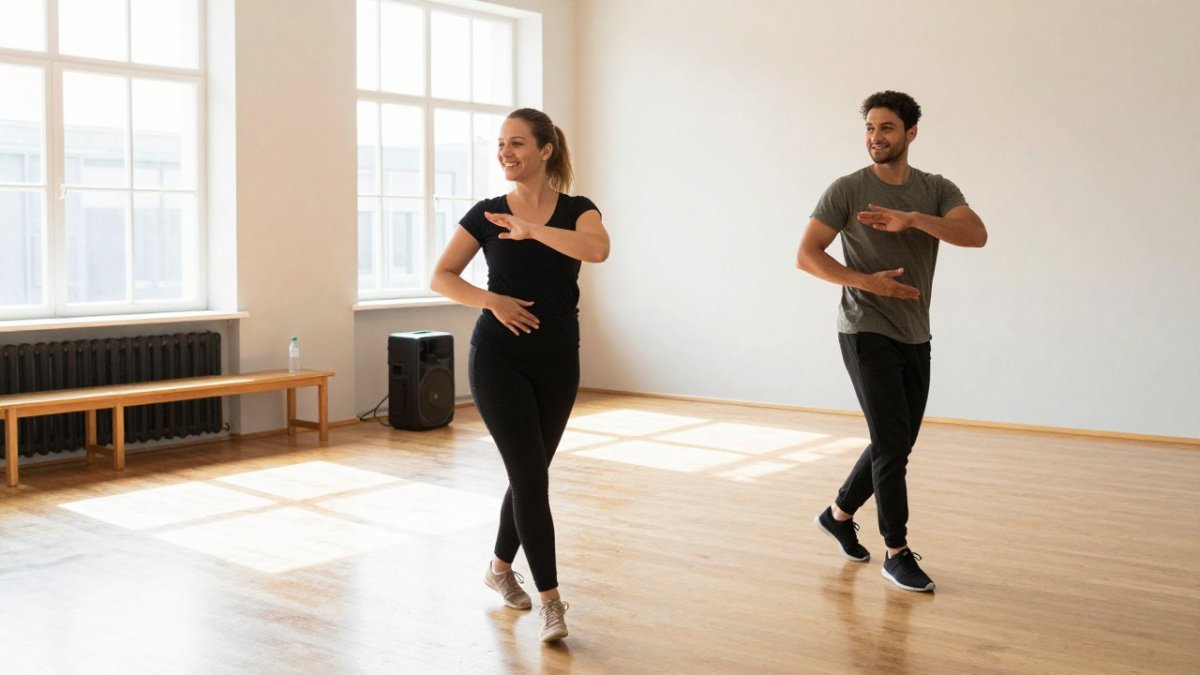
Stand facing each other and mirror each other's footwork.
Take turns leading the basic step while your partner follows.
Practicing solo builds your own timing. Practicing with a partner teaches you to follow and to lead. For solo footwork without a partner, an open-level Dominican Bachata Bootcamp covers footwork and musicality in two hours. Our Bachata Dominicana Solo/Choreo Workshop is a good place to drill solo combinations with guidance.
A Timed Beginner Practice Routine You Can Do at Home
Set a timer and work through this routine three times a week:
Warm up (3 minutes): March in place to the beat.
Basic step (5 minutes): Drill the three-step pattern and tap.
Side-to-side drill (5 minutes): Switch sides on every eight-count.
Combinations (7 minutes): Run through two or three combinations slowly.
Cool down (2 minutes): Shake out your legs and breathe.
Short, regular sessions beat one long session. Ten minutes a day adds up quickly.
Common Footwork Mistakes and How to Correct Them
Most beginner errors come from rushing. Here are the usual culprits:
Mistake | Correction |
Stepping on the wrong beat | Count out loud and slow the music down |
Locking the knees | Keep knees soft and bend slightly |
Forgetting the tap | Mark beat 4 with a visible tap |
Leaning weight forward | Keep your torso upright and centered |
A common mistake is practicing too fast. Slow down until the count feels automatic, then speed up.
Booking Your First Beginner Bachata Class with Latin Soul Dance
Practice at home builds a solid base, but a live class lets an instructor catch mistakes you can't see yourself. Our classes welcome dancers of every level, and our supportive instructors give simple step-by-step guidance. You can compare our beginner-friendly bachata classes in The Hague to find the right fit.
If you're not sure which class fits you, our guide to choosing a dance class explains the options. Ready to start? Let's Dance: book your first class with Latin Soul Dance today. If you prefer one-on-one coaching, see what to expect from your first bachata private lesson.
Frequently Asked Questions
What are the basic bachata steps for beginners?
The bachata basic step is a three-step pattern danced over two counts of music: a step forward or side, a step back or together, and a tap on the fourth beat. Beginners usually start with the box-like side-to-side version, keeping weight on the ball of the foot and staying relaxed through the knees. Practise the pattern slowly with a steady count of one, two, three, tap until the footwork feels automatic before adding hips or arms. Latin Soul Dance teaches these basics step by step in beginner-friendly classes.
How do you practise bachata footwork at home?
Clear a small space, play a slow bachata track, and count out loud while you step. Work in short sessions of ten to fifteen minutes, focusing on one drill at a time, such as the basic step, the tap, or side-to-side transitions. Use a mirror or record yourself to check that your weight shifts cleanly. Repetition at a slow tempo builds the muscle memory that makes faster music manageable.
Can you learn bachata footwork without a partner?
Yes. Solo practice is the best way to build the footwork itself, because you can control the tempo and focus on foot placement without managing a lead or follow. Once the basic step feels comfortable alone, practise it with a partner to learn connection and timing together. Many beginners find that solo drills make partner classes feel far less intimidating.
How long should beginners practise bachata footwork each day?
Ten to twenty minutes a day is enough for most beginners, split into two or three short sessions if that is easier. Consistency matters more than length: a short daily routine builds coordination faster than one long session each week. Stop before fatigue sets in, since sloppy repetitions reinforce the wrong patterns.



Comments